

14th March 2007 | Draft
Abusive Wikipedia Biographical Editorial Process
a case study in problematic alternative forms of governance?
-- / --
Various amendments to this text have been made as inserts on 5 June 2009, in the light of information available
Background
The 1300 articles on this personal website have been developed over the years with considerable assistance from Wikipedia. Appropriate links have been supplied to Wikipedia entries wherever possible in order to support the process. Very little material has been copied from Wikipedia during that process. This is an indication of appreciation of the service.
Professionally my work has involved responsibility for editorial and computer systems development, within an international nonprofit information clearinghouse, for a set of databases -- many of whose entries could have been adapted for inclusion in Wikipedia. This option has been discussed. Several of the databases are in fact biographical. I have been responsible for their design and use.
Whilst admiring the Wikipedia facility, I have not sought to develop an entry either on the above services or on myself. The former was done by others for a number of entries, including that on the century-old organization (Union of International Associations), its founder Paul Otlet, and some of its key services (Yearbook of International Organizations, Encyclopedia of World Problems and Human Potential) for which I had been responsible. With respect to myself, although already cited by others in other entries in Wikipedia (Unified science, Systemantics), I have not attempted to create a biographical entry -- being satisfied with my own website and its coverage by search engines. Nor have I attempted to acquire any skills in editing Wikipedia entries -- or acquiring an account.
Versions of my biography have been presented on various websites, without necessarily informing me before the fact. At the time of writing, my current bio on this site is dated 2002 -- an indication of my interest in the matter.
Incident
Without being requested to do so, on 8-9 March 2007, a friend inserted into Wikipedia several biographical entries (including one on myself) on individuals with an historical involvement in the international futures movement. Those so documented were informed by my friend by e-mail.
On examining the entry, there were a variety of things that were unacceptable, inaccurate or incomplete -- for an encyclopedia. I was faced with the challenge of what to do about the matter.
Another friend, with considerable Wikipedia expertise, pointed out that the entry was, for a start, unhelpfully named as "Anthony J.N. Judge" -- no spaces between initials. He appropriately repositioned it to "Anthony Judge" and redirects were inserted from the incorrect variant and from "Tony Judge". He activated the links to other entries in Wikipedia for the organization and services named above -- which I had for many years been responsible, if I had not initiated them. My friend warned me that in its current state it ran the risk of being scheduled for early deletion.
The challenge was then -- speedily (and with no consideration of other commitments I might have) -- to edit the text to correct content errors, add appropriate material and adapt the style to a more acceptable Wikipedia entry style (whatever that was) -- since it had mainly been pasted in from another variant on another site.
This meant opening an account in Wikipedia, which I did without any trouble. I proceeded to edit the text into a more satisfactory condition -- my first technical and stylistic experience at having to edit such an entry. However I have a lot of experience with HTML, so this was not a problem -- and the preview facility worked well. How would others have fared if required to work in haste and without experience -- especially if they felt strongly about being misrepresented?
When I had finished I attempted to save the entry. I was confronted with an "Edit Conflict" message indicating that someone else ("an administrator"?) had been able to ignore the fact that I was working on the entry and had asserted priority rights to mark up the initial version of the entry. Surely an elementary software deficiency? I have personally programmed software to avoid such conflicts.
The entry had been so marked as containing "blatant advertising" and scheduled for "speedy deletion" -- when I understood what was going on. A facility was however offered for me to contest such speedy deletion, provided I marked up the text with a "hang on" message. This I finally discovered how to do correctly -- however in the process I lost all the modifications on which I had spent a significant amount of time. Was that the intention? The entry then stood in its unmodified form -- as it had been before my personal involvement and the time wasted in the process.
The "speedy deletion" message encouraged me to justify my request to "hang on" by use of the talk/discussion facility -- indicating that this would not necessarily preclude its deletion. This I did -- without knowing what constituted a legitimate justification. However I was faced with the fact that I could not (or did not know how to) insert revisions -- especially since my first set seemed not to have been retained by the system due to the intervention of the "administrator". No feedback was offered in the "discussion" facility.
I then found, after revising my very mild explanatory comments on the relevant talk page, that (as per advice to those vetting such pages) my name had now been associated with a "spam warning" -- whatever that was supposed to signify and to whom.
I have since been informed that the page was deleted -- but have made no further attempt to engage in the process. [Subsequently I have noted that a version of the page has been reinstated (Anthony Judge), seemingly with the fruitful intervention of another colleague engaged in the Wikipedia process and sympathetic to my initiatives. But clearly it serves no purpose for me to read the text since I am not free to correct it, merely to lobby others to correct it or to respond to their invitation to indicate what it might be appropriate to amend.]
Comment
The interesting features of this process were:
- Finding myself obliged to respond to erroneous information inserted into Wikipedia (fortunately having been warned that information had been inserted about me). How might others fare -- especially if not so informed?
- Having rapidly to acquire skills to make amendments (irrespective of other commitments), even though I have more experience than many in the technicalities of HTML-style editing. I pity those without those skills faced with totally erroneous information.
- Having to work rapidly with the implied threat of "speedy deletion" -- otherwise termed being "under the gun"
- Being faced with a generic message warning of imminent "speedy deletion" -- but without offering the slightest explanation on the specific items that were unsatisfactory according to Wikipedia style, or indication of appropriate guidelines
- Being apparently confronted with inability to save revisions due to imposition of a blocking message
- Being required to justify myself in the face of an unsubstantiated generic accusation -- a situation more generally contested as an abuse of human rights
- Without receiving any feedback on the adequacy of my justification -- as is typical of what kind of legal system?
- Being faced with an environment in which there was every probability that, no matter what I did, the modifications would be rejected and the entry deleted -- after I had wasted time in the attempt
- Discovering that there was no obvious complaints procedure -- no ombudsman-type service, no help service -- especially under time pressure. Ironically searching for "wikipedia complaint" points to an entry in Wikipedia on the nature of "complaint" -- not about the editorial challenges of using Wikipedia.
| Revision of June 2009 |
| I had been informed some months ago that an entry had been reinstated, following a process of which I am not aware. I have avoided visiting the page. What should (or could) I do about correcting or enhancing it under the circumstances? More generally, what can anyone do in defending the manner in which they are portrayed -- other than by engaging in the development of alliances with those who have some interest in making such amendments. To what extent does the subject of a biographical entry have to commit to a protective engagement with the Wikipedia process -- even an agresssively protective one? What of those without such inclinations? |
Conclusion
Some responses to the above experience:
- Finding myself, within a few hours, totally alienated from a service which (as a researcher) I have probably been using 30-50 times a day for a number of years
- Concluding that, as had been my previous position, I had absolutely no interest in the process of providing a biographical entry to Wikipedia or ensuring that it was correct.
- Assuming that many others faced with this situation must recognize that Wikipedia is building up a reservoir of incorrect articles -- especially where, as in the case of biographical entries, it is the person described who is typically best equipped to validate the content, but who may be faced with unfriendly obstacles to any content improvement (irrespective of whether they have the skills to do so)
- Recognizing that my preference, and my recommendation to others, faced
with pressure from colleagues to include such an entry, is to minimize its
length and simply point to one's own website:
- where appropriate links can be provided
- where one can work on its improvement at one's own pace according to one's own style
- without being subject to "speedy deletion" for failure to meet unspecified biographical criteria
- without being obliged to check periodically (daily?) -- for the remainder of one's natural life -- whether one's biographical entry in Wikipedia had been inappropriately modified by the misinformed
- Accepting that, whilst Wikipedia indeed needs to guard against abuse, it needs to give attention to the abusive use of its policing facilities and the software support provided for that process -- or be faced with accusations that it might prefer to avoid
- Specifically, if Wikipedia has any interest in doing so, it should offer immediate and obvious access to a "helping hand" (to those faced with the above situation) -- as has been characteristic of many internet services (from the time of the NSF/EIES facility in the 1970s, from which I benefitted).
- Having admired (and repeatedly extolled to others) the "magic" of the Wikipedia process over the years as being an "inexplicable" feature of emergent organization, the above experience has raised the nasty suspicion that rather than being dependent on the emergent values of an "open society" model (as frequently claimed), its success may well depend on other processes more closely associated with the vigilante dynamics characteristic of far more dubious political systems. No one ever denied that such systems could be highly efficient -- and many of course benefit appreciatively and unquestioningly from the exercise of such "vigilance", irrespective of the hidden collateral damage. A pity -- but how is Wikipedia to prove otherwise?
Afterthoughts on democratic governance and transparency
It is entirely probable that:
- biographical guidelines are available for Wikipedia, the issue is rapid access to them under the circumstances described
- help facilities are indeed available, but under unspecified circumstances given the time constraints -- especially given time zone issues
- complaints procedures are available, notably through some appropriate discussion facility, again without obvious pointers being immediately offered to such a process
| Revision of June 2009: Guidelines and help facilities |
It is appropriate to reflect on the above Wikipedia process as a metaphor of some aspirations to alternative styles of governance in wider society -- and the manner in which they are undermined in practice, despite goodwill on the part of many:
- on investigation it is possible that the above incident would be framed as a "misunderstanding", perhaps a regrettable consequence of "over-zealousness" on someone's part -- familiar echoes of exceptionalism and special pleading in other contexts
- facilities and guidance may indeed have been available -- ignorance of the "small print" is never a valid plea before the law, whatever the time pressure
- environments may well exist for appropriate arbitration, but in the Wikipedia case, these "courts of appeal" may for the plaintiff bear a strong resemblance to military tribunals in which the possibility of being appropriately defended in a timely manner is totally illusory, despite claims to the contrary (one strong reason for not attempting to register the above issue within the Wikipedia environment)
- the above process is reminiscent of the challenges faced by those arrested "on suspicion" and pressured by security forces to formulate a statement in defence of their activities -- in some cases literally "under the gun"
- as a supposedly truly democratic process, the flaw in such a claim is that if one does not want to have a biographical entry in Wikipedia and does not want to defend one's interests within Wikipedia processes (in which one has to develop skills one may not wish to acquire), then one is effectively disenfranchised and marginalized -- even if an entry is nevertheless created by some other person(s)
- "speedy deletion" of a biographical entry is an interesting metaphor for which some experience the physical reality within processes that are remarkable analogous to those described -- an unfortunate use of a metaphor employed by many security services (described elsewhere by Michel Bauwens as "deletionism", this aspect of the Wikipedia process bears an interesting relationship to that of "targetted assassination" as promoted by some democracies)
- being labelled with a "spam warning", as a consequence of such a process, is clearly analogous to acquiring a criminal record within Wikipedia -- and being unable to inspect it, appeal it, or have it cleared, or have any guarantee that this has been done (rather than being secretly maintained)
It would seem that there are indeed issues that Wikipedia could fruitfully address. One option is of course to block any access by someone such as myself -- without making clear that that is a typical response to criticism even in its mildest form. Again echoes of recent new government legislation in response to dissidence and protest?
As one of the few viable and successful models of an alternative form of governance, there is a strong case for analyzing the governance and security processes of Wikipedia in the light of structures and processes explored (and criticized) in modern government. It would seem that there are a number of features that are potentially questionable or call for greater transparency. Or is Wikipedia simply replicating some of the problematic processes of democratic governance in order to ensure its viability?
Potentially even more interesting in such an analysis is any comparison that might be made between the Wikipedia community and an extended religious community such as the Islamic Ummah -- or perhaps its Catholic or early Protestant equivalents. As with Wikipedia, discipline within such communities is maintained by a set of edicts -- the Sharia in the case of Islam. Conformity is ensured by some form of religious security apparatus -- the religious police of some Islamic countries. Note in paticular the status of mullahs and the nature of their accountability. Analogous ideological security forces were a characteristic of some political regimes in the 20th century -- even at the neighbourhood level. The "magic" of the editorial process of Wikipedia with its thousands of "volunteers" needs to be reviewed in this light -- who exactly is a "volunteer" and what is their motivation in such a system of governance? How would such a system of governance work in the case of alternative forms of environmental security -- environmental vigilantes? Is the dynamic of "speedy deletion" to be fruitfully compared with that associated with a "lynch mob"?
The operation in the USA of the House Committee on Un-American Activities (HUAC or HCUA) (1938-1975) offers another possibility of comparison -- especially now that the US religious right is launching the Conservapedia as a "rival to 'un-American' Wikipedia" [more]. The contrasting policies of Scholarpedia.org and Citizendium.org merit examination.
The irony is that instead of wasting time on production of this case study, I could have devoted more time to attempting to meet the biographical criteria of Wikipedia -- whatever the probability of the entry being spiked yet again. A mug's game.
| Revision of June 2009: Implications for a future Wikistrategies or Wikisolutions |
With respect to the forthcoming State of the World Forum (November 200), proposals have been made by that group for the development of some form of Wiki for solutions to the world's problems (see Global Solutions Wiki). Historically this follows from the development in the 1990s of the Global Strategies Project (for which I was responsible) -- a database of online profiles of 32,547 strategies and solutions (with 284,382 links) advocated by international constituencies (singly or in collaboration) and linked to similarly profiled world problems. The relevance of mentioning this newly proposed initiative, in the light of the dynamics of Wikipedia, is to raise the question of how "solutions" or "strategies" -- many necessarily controversial -- are to be processed within such a context. Are "solutions" to be subject to the same problematic editing processes (already evident in controversial problems in Wikipedia) as is clearly the case with biographical entries? How is it to be determined whether the profile of a proposed strategy is primarily hopeful promotion by its advocates? Or, if so, what "counterclaims " are to be presented as in the profiles in the Global Strategies Project? Some of these issues are discussed separately as part of a commentary on the State of the World Forum event (see Global Solutions Wiki). |
References
At the time of writing (March 2007), "scandals" relating to the Wikipedia editorial and arbitration process -- notably with respect to biographical entries -- were being widely reported in the media (and accessible via search engines). For example: Alex Beam (Meanwhile: My sticky Wiki, The Boston Globe, 13 March 2007) who was only able to get a correction made to his erroneous bio entry through a personal connection to the founder of Wikipedia. Subsequently, Michel Bauwens reviewed a range of related issues and sites preoccupied by them (Is Something Fundamentally Wrong with Wikipedia Governance Processes, 7 January 2008).
Subsequent to the above comments, it is appropriate to note:
- the challenges arising from struggles for control of editorial content of Wikipedia between 'inclusionists' and 'deletionists' have been highlighted by Bobbie Johnson (Wikipedia approaches its limits, The Guardian, 12 August 2009)
- according to Bobbie Johnson, after a lot of behind-the-scenes arguments, Wikipedia seems set to adopt changes that will make it much harder for contributors to edit the site (Wikipedia brings restrictions into force, The Guardian, 25 August 2009, with some 300 comments). So-called "flagged revisions" will mean that any change to an article about a living person will need to be approved by an editor. Other procedural changes have been proposed (Wikipedia editors may approve all changes, The Guardian, 27 January 2009) notably following such concerns regarding the accuracy of articles referring to living people.
- on the occasion of the lead up to the UN Climate Change Conference in Copenhagen (December 2009), given notable focus by the "climategate" e-mail hacking crisis, it emerged that a senior Wikipedia editor had been manipulating the content of 5,428 climate articles such as to undermine the objectivity of entries on anthropogenic global warming and on the Climategate incident itself (Lawrence Solomon, Wikipedia's climate doctor, Financial Post, 19 December 2009; James Delingpole. Climategate: the corruption of Wikipedia. The Telegraph, 22 December 2009). The entry on Lawrence Solomon in Wikipedia refers to his criticism of Wikipedia.
In Memoriam Subsequent reflection following the "deletion"
of Ralph Siu (January 2008) The entry on R G H Siu has just been deleted from Wikipedia, despite references to his name in connection with panetics (the study of suffering) which was the preoccupation of a research program and organization that he instigated (the International Society for Panetics). The entry on panetics is also marked as being considered for deletion. Siu continues (for the moment) to be mentioned in the Wikipedia entry on suffering. Siu was an early pioneer in creating a bridge between Eastern and Western cultures, notably in his work on taoism and science (published by MIT Press). These,with other publications on taoism and management (published by Wiley), he subsequently framed as a 12-volume collection (The Quantum and the Tao: an unified East-West psychophilosophical synthesis toward harmonious living). The volumes, with an indication of their contents are listed by a project of the Special Integration Group (SIG) -- of the International Society for the Systems Sciences (ISSS) originally Society for General Systems Research (SGSR) and the International Institute for Systemic Inquiry and Integration. Siu is an exemplar of lifelong dedication to complex issues having fundamental humanitarian implications. The unseemly haste with which an honourable scholar has been "deleted", by what amounts to a rabid editorial lynch mob, is a sad commentary on the democratic dynamics which many had so hopefully associated with Wikipedia as an alternative model. The intellectual quality of the dialogue relating to the proposed deletion of panetics is also a sad commentary on collective ignorance and the "unwisdom of crowds" at a time when suffering is simultaneously a preoccupation for many that experience it and of relatively little interest to the research community. The removal of Siu focuses attention on historical revisionism and censorship as it effectively results from criteria of editorial quality and haste. Clearly, the bias favours the crowd and that which is known to the crowd; hence the extent to which currently favoured bands and groups, using the names of fundamental human values, displace those values in any web search facility. Wikipedia and Google (or their future competitors) could therefore usefully consider a longer time span in weighting relevance of web content presented through their services -- or find that they serve increasingly to obscure larger contexts in favour of the fashionable present even when it is later only of historical significance (if any). For how many decades, for example will the Wikipedia entry on the NY band Mindless Self Indulgence continue to be retained as an authoritative indication of modern global preoccupations -- obscuring the absence of any entry on self indulgence that is the cause of so much suffering (as studied by Siu)? And yes... like the founder of international peace research, I am indeed one of the people who has specifically written on R G H Siu, most recently in a lengthy review, with numerous references to panetics research:
and prior to that in the enrichment of the Encyclopedia of World Problems and Human Potential for which I was responsible. Of relevance in that respect are the criteria, and dilemmas, for inclusion and exclusion of "world problems" (notably in terms of their subjective importance to those constituencies identifying with them, and motivated to action by them). The challenge was to enable a framework for interrelating incompatible perspectives. Curiously one of the assertions of the Wikipedia editors advocating "deletion" was that the contents of the entry text on Siu were "nonsense". Unfortunately in a complex world, the perspectives of most with whom we disagree are necessarily (if not by definition) "nonsense" -- whether politically, theologically, from another disciplinary framework, or in terms of level of expertise. And no...engaging with the democratic dynamics of a lynch mob editorial process is something I did not seek to do -- for the reasons indicated above. [Note in June 2009: The entry in question had
been rapidly reinstated |
***
Learning from the Psychosocial Significance of "Masked Judges" In seeking to clarify the parallels between Wikipedia editorial judgements (together with other situations where anonymity is advocated, peer review, etc) and the phenomenon of "masked judges", a preliminary web search indicates materials such as:
When is anonymity appropriate? What are the legitimate concerns regarding "faceless" bureaucrats? What is now perceived to be so intentionally sinister about the lynch mob activity of masked members of the Ku Klux Klan and their sense of their own legitimacy? How is any abuse by "masked judges" or "faceless bureaucrats" to be remedied? It would seem that the comparison with Wikipedia editorial processes merits some reflection -- if only very briefly to avoid exaggeration and inappropriate acusations. Those involved on the Wikipedia side could be fruitfully part of such a process. Curiously, in a world focused on issues of security, even leading democracies increasingly require by law that people in public places should have their faces unconvered -- for security cameras. It is therefore somewhat ironic that, as a purportedly open democratic process, Wikipedia editors should be "electronically masked". It is curious therefore that in Jimmy Wales own biographical entry in Wikipedia he should be quoted as saying: "This is fundamental, basic information about the world. It needs to be neutral, and there needs to be an accountable, transparent, public dialogue about how it's created." He further stated, "I trust Google reasonably well, but that's like saying you have a favorite politician. I trust this politician, but I still want the city council to meet publicly. I still want a certain transparency in how government is run, even if you trust the person who's in charge now." Should the "city council" be "masked"? |
***
| An emergent symbolism: Wikipedia and The
Fates --
of cyberspace -- mythological models of Wikipedia editorial adjudication? |
| In Greek mythology, the white-robed Moirae (in Greek the "apportioners", often called the The Fates) were the personifications of destiny (Roman equivalent: Parcae, euphemistically the "sparing ones", or Fata; also equivalent to the Germanic Norns). They controlled the metaphorical thread of life of every mortal and immortal from birth to death (and beyond). Even the gods feared the Moirae. Zeus (Jimmy Wales?) also was subject to their power, as the Pythian priestess at Delphi once admitted. The Greek word moira literally means a part or portion, and by extension one's portion in life or destiny. |
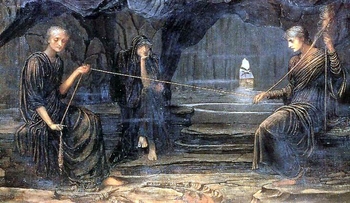 |
| From Wikipedia entry Moirae / The Fates by John Strudwick, A Golden Thread, 1885 (although ironically the scissors/shears carried in the hand of the figure in the middle are not clearly evident) |
|
For further updates on this site, subscribe here |
